I recently created this video to help explain how our company, PharmAcheive, trains pharmacists to pass the Pharmacy Examining Board of Canada's (PEBC) OSCE exam. It is an oral exam where professional actors trained to be indistinguishable from real patients interact with examinee. The examinees must solve the case presented to them by the patient.
Sunday, March 21, 2010


Saturday, April 04, 2009
Mira Katirai Web Site
I spent a considerable amount of time helping to launch the Mitra Katirai web site. The web site contains:
- A search engine with more than 10,000 real estate listings of homes for sale in Toronto, North York, Richmond Hill, Vaughan and Markham -- and it lets you visualize what's for sale in your area in the form of a Google Map.
- An Ontario and Toronto Land Transfer Tax Calculator.
- Neighborhood reports including ones listing the best schools, and the relative crime rates of different neighborhoods.
Saturday, January 10, 2009
Launch of PharmAchieve
Over the last few months I've been actively working with PharmAchieve -- an organization that mentors foreign pharmacists to pass the oral exams required to become licensed in Canada. We bring together professional actors trained by local medical schools to be indistinguishable from real patients to create realistic scenarios. In each scenario, the pharmacist must interact with a patient to solve a case. Each case takes place under the observation of a licensed pharmacist who evaluates the interaction and provides the student feedback.
Our setup mimics the Pharmacy Examining Board of Canada's OSCE exam required for licensing in Canada. All of the lead instructors who teach the lecture component of the course received their training from Harvard Medical School. The licensed pharmacists who observe and evaluate the students are almost all from University of Toronto -- several of whom have certifications in Geriatrics, Asthma, Diabetes. Several have advanced degrees such as PharmDs.
The growth of PharmAchieve has been nothing short of amazing. In less than a year, we have outgrown our Yonge Street location near Yonge/Finch in North York to a Bay Street location.
Our setup mimics the Pharmacy Examining Board of Canada's OSCE exam required for licensing in Canada. All of the lead instructors who teach the lecture component of the course received their training from Harvard Medical School. The licensed pharmacists who observe and evaluate the students are almost all from University of Toronto -- several of whom have certifications in Geriatrics, Asthma, Diabetes. Several have advanced degrees such as PharmDs.
The growth of PharmAchieve has been nothing short of amazing. In less than a year, we have outgrown our Yonge Street location near Yonge/Finch in North York to a Bay Street location.
Tuesday, August 15, 2006
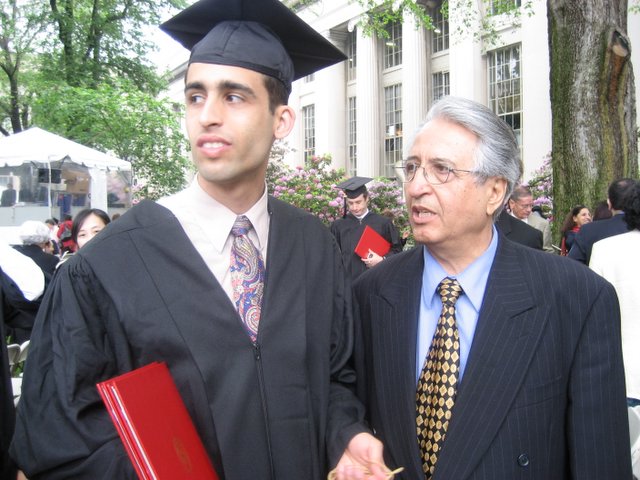

Our Graduation Reception

A few Baha'is graduated at the same time, so we decided to have a joint graduation reception. Here's us cutting the cake.


Saturday, May 06, 2006

Wednesday, May 03, 2006
An Evening with Noam Chomsky
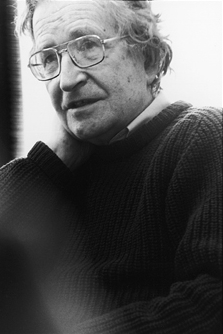
I've been studying at MIT for 3 years, but until last night had never seen Noam Chomsky. Last night, my class had a private question and answer dinner with him. For those that don't know who he is the:
- Most cited person in the world that is still living.
- The person who single handedly invented the field of linguistics, and the theory used by computers to understand computer languages
- A well known political dissident -- especially of US foreign policy.
You keep quoting Chomsky.Such is the power of Chomsky: Love him or hate him; you simply can't ignore him.
Why are you quoting Chomsky?
He's not here.
*I* am here.
At this evening, there was no planned agenda; just a night of questions from my classmates who had crowded into a tiny room. It was easily the most well attended event our class's society had organized all year -- because people like me, came out of their thesis cubby holes to see it. What surprised me was how mild mannered his voice was.
I gave him a copy of Hatcher's Love, Power and Justice, and Foad Katirai's "Global Governance and the Lesser Peace" and was excited by an invitation to "come by sometime" to his office to talk more about the books.
Sunday, April 30, 2006
How to predict divorce with more than 94% accuracy
John Gottman, has created a model that can predict whether a couple will divorce with 94% accuracy. I first heard about it at an Association for Bahai Studies conference in Toronto.
The model was created by studying more than 700 couples for more than a decade.
To apply model, Gottman videotapes a couple discussing a contentious issue for 15 minutes. A team then reviews the tape to identify all instances of pre-specified positive and negative behaviors.
For example, the introduction of humor during a tense moment, is given a score of +4, while the rolling of the eyes is given a score of -4. A nod, to acknowledge the other person's point is given a score of +1.
If the ratio of positive to negative scores isn't at least 5:1, the couple is predicted to divorce.
He has produced a number of interesting books accessible to the public including Why Some Marriages Succeed while Others Fail.
The model was created by studying more than 700 couples for more than a decade.
To apply model, Gottman videotapes a couple discussing a contentious issue for 15 minutes. A team then reviews the tape to identify all instances of pre-specified positive and negative behaviors.
For example, the introduction of humor during a tense moment, is given a score of +4, while the rolling of the eyes is given a score of -4. A nod, to acknowledge the other person's point is given a score of +1.
If the ratio of positive to negative scores isn't at least 5:1, the couple is predicted to divorce.
He has produced a number of interesting books accessible to the public including Why Some Marriages Succeed while Others Fail.
Friday, March 24, 2006
Movies that Matter: Trading Races
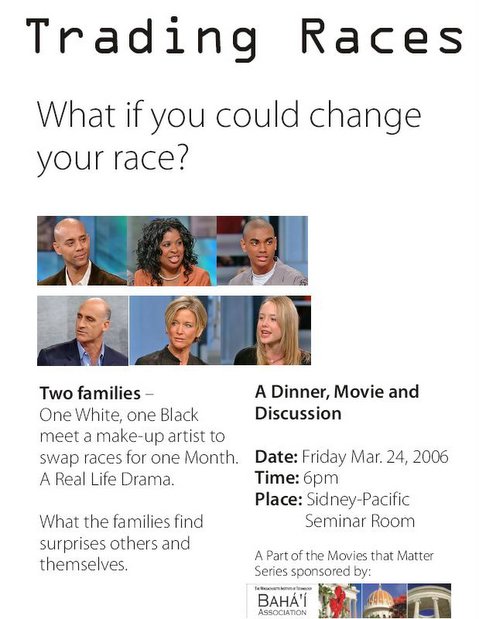
A poster I designed for our latest Baha'i club event designed to facilitate a discussion on race. We viewed an Oprah episode discussing the experiences of two families -- one white, one black. By meeting a hollywood makeup artist they were given the unique experience of temporarily changing their race.
Friday, December 09, 2005
The Doctor is In
Sorry I've been incognito for a while -- I'm in the whirlwind of exams, finals, projects, and job interviews -- all the activities you go through when finishing school. But I had to poke my head out of hibernation to talk about this new find: A band called Tree Wave.
They make innovative music using obsolete computer equipment (including a Commodore 64 and a Dot Matrix printer) and female vocals. But before you dismiss the band's concept as too out there to possibly be any good, give them a listen. In the words of one reviewer
"...it isn't the bleep and bloop-fest you might expect, it is really quite lush...."
and another
"...they make remarkably sublime music...strangely beautiful, but definitely warm inside...."
The guy takes advantage of an analog synth built in to a Commodore 64 -- who would have thought! Here's a link to some of their songs.


They make innovative music using obsolete computer equipment (including a Commodore 64 and a Dot Matrix printer) and female vocals. But before you dismiss the band's concept as too out there to possibly be any good, give them a listen. In the words of one reviewer
"...it isn't the bleep and bloop-fest you might expect, it is really quite lush...."
and another
"...they make remarkably sublime music...strangely beautiful, but definitely warm inside...."
The guy takes advantage of an analog synth built in to a Commodore 64 -- who would have thought! Here's a link to some of their songs.
      |
Wednesday, October 12, 2005
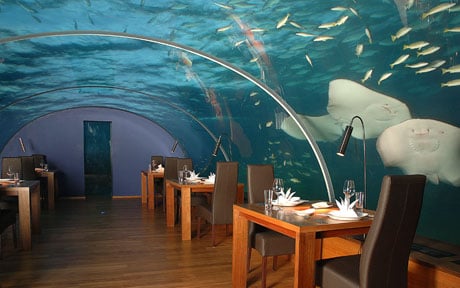
World's first undersea restaurant

Thursday, July 28, 2005
At the beach at 4am
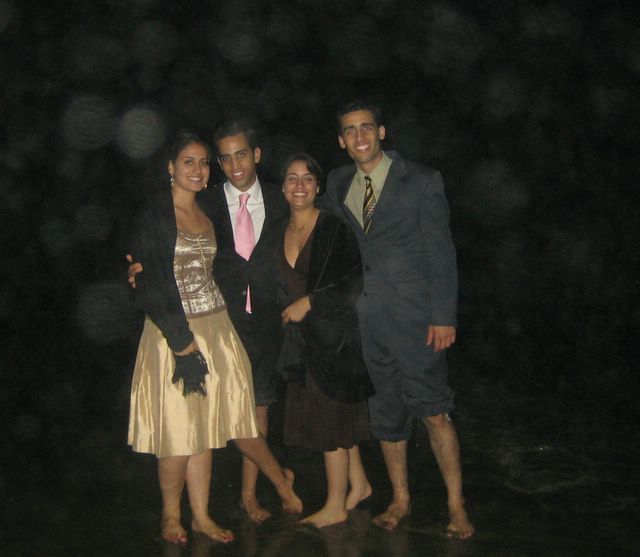
A few weekends ago, I experienced my first Beverely Hills wedding. There I met tons of cousins I never knew I had. It was kind of funny because I took a look at the map my parents were using to drive to an afterparty. The address? In Beverely Hills, 90210 :) This picture was taken after the party, when one of the locals took us to the town then to the beach.


Sunday, July 10, 2005
Whitewater Rafting
In Seattle, people seem to enjoy nature more often -- by going on hikes, camping, etc. This weekend I went whitewater rafting with some friends from Microsoft. Shown below is a 14 foot drop at one part of the journey. I'm the guy on left in the front row.





Thursday, June 23, 2005




Saturday, June 18, 2005
Wednesday, May 25, 2005
This blog was cited in alumni newsletter
This appeared in this month's MIT Alumni Association newsletter
"Full of photos of everything from transparent concrete to lights attached to bicycle spokes, notes on how to hack a Pepsi bottle, and thoughts from a negotiation class called Playing to Win vs. Playing Not to Lose, engineering systems division graduate student Hooman Katirai offers a humorous and insightful look at life in his blog, Treadmill to Infinity."
Tuesday, April 26, 2005
Thought of the Day: On Taking Risks
"Looking back in 20 years, you are less likely to regret the risks you took now, than those risks you did not take."
-Author Unknown
Friday, April 22, 2005
Playing to Win vs. Playing Not to Lose

I realized in negotiation class today that some people play to win, while others play "not to lose."
To use a baseball analogy, people who "play to win," feel comfortable walking a batter to load the bases. They are fine with trusting people and taking some calculated risks if it increases their chances of winning.
On the other hand, people who "play not to lose," are driven by their fear of getting hurt. They seek to protect themselves at all costs. They are very hesitant to trust other people and are pre-occupied with avoiding risks.
Of course, there is a spectrum between these two extremes. But my life philosophy is that a strategy solely focused on "playing not to lose" isn't very effective.
Years ago my father told me to "never do business with people you don't trust, because in the end you will always lose." No matter how comprehensive your contract, no matter how airtight your patent, they will find a way around it.
If you find yourself emphasizing the "playing not to lose" mode of thinking when crafting a partnership, ask yourself "am I dealing with people I don't trust?"
An obsession with protecting oneself from harm doesn't serve to create anything of value. It's what can be termed a "negative" strategy, because it is focused on what you "don't want to happen."
If you are to truly benefit from the what a partnership can bring, you need to also foster a culture of co-operation that make partnerships work and to clarify the benefits of the partnership both to yourself and your partners. This is a "positive strategy" insofar as it focusea on what "you want to happen."
Lacking a positive strategy, you are basically assuming your partnership will fail.
So the optimal solution seems to be the middle road: (1) introduce safeguards into your agreements but (2) Develop a vision of a successful partnership and (3) clarify and publicize both for yourself, your partners, and employees, the benefits of the partnership and (4) to maximize the chance of success, find ways to allow people at all levels in both organizations to foster strong working relationships.
Transparent Concrete
While waiting to meet someone in the library, I browsed Domus (an amazing Italian Designer magazine), and noticed they had an article on transparent concrete. They were trying to figure out how to use the new medium. One of their pictures was very beautiful. The picture below, is not as beautiful as the one I saw. But it should give you an idea of this new medium.

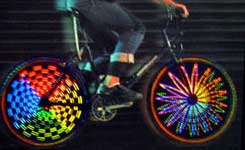
Bicycle Lights that can display computer generated patterns!
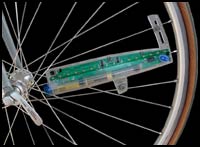
Attach this to a spinning bicycle wheel,
and you get this:
A blue version:
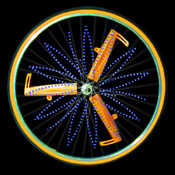
the thing can even connect to a palm pilot to display custom text:

Hokey Spokes are unique bicycle safety lights that allow riders to display computer generated images while riding at night.
I wouldn't want to be seen riding with these lights, but they are pretty remarkable.
I found this while browsing Cool Neon's store.
Speaking of which, Cool Neon sells plastic wires that glow when connected to a power source. You can make some pretty funky stuff using this wire; for instance, check this "modded case" out:
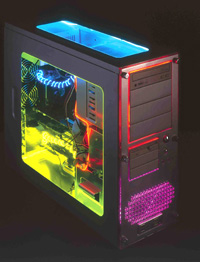
Some of my friends created interesting halloween costumes using Cool Wire. Speaking of which I'm trying to find an excuse to use some too -- it's only $1.00 per foot on sale and it lasts 800 to 3000 hours.
and you get this:
A blue version:

the thing can even connect to a palm pilot to display custom text:

Hokey Spokes are unique bicycle safety lights that allow riders to display computer generated images while riding at night.
I wouldn't want to be seen riding with these lights, but they are pretty remarkable.
I found this while browsing Cool Neon's store.
Speaking of which, Cool Neon sells plastic wires that glow when connected to a power source. You can make some pretty funky stuff using this wire; for instance, check this "modded case" out:

Some of my friends created interesting halloween costumes using Cool Wire. Speaking of which I'm trying to find an excuse to use some too -- it's only $1.00 per foot on sale and it lasts 800 to 3000 hours.
Subscribe to:
Posts (Atom)